

Who Makes the Best Thermal Sticker Labels in China?

Choosing who makes the best Thermal Sticker Labels in China is not simply a price comparison. These labels must print cleanly, feed smoothly, and remain readable through storage and handling. A faint barcode or lifted corner can slow a busy packing line. Small details matter.

Industry reports help explain why supplier quality deserves attention. Smithers’ report, The Future of Label Printing to 2028, forecasts continued expansion in the global label-printing market, with its value projected to reach about US$58.5 billion by 2028. That figure covers label printing broadly, not thermal labels alone. Still, it signals a growing market where consistent production and dependable materials are increasingly important. A market forecast is useful, but it cannot verify an individual factory’s performance.

A practical supplier review should look beyond polished product photos. Ask for samples, adhesive specifications, roll and core dimensions, and test results for print darkness and barcode readability. Check whether the factory can explain how its materials perform on your actual printer and packaging surface. Request evidence of quality controls, production capacity, and batch traceability. Then compare the same specifications across quotes.

There is no universal “best” maker. A label that performs well on corrugated cartons may not suit chilled goods or smooth plastic. Samples can reveal flaws that a brochure misses. And, honestly, a sample run cannot guarantee every future batch. The strongest choice is a Chinese manufacturer that answers technical questions clearly, supports repeat orders, and can demonstrate consistent results under your real operating conditions.
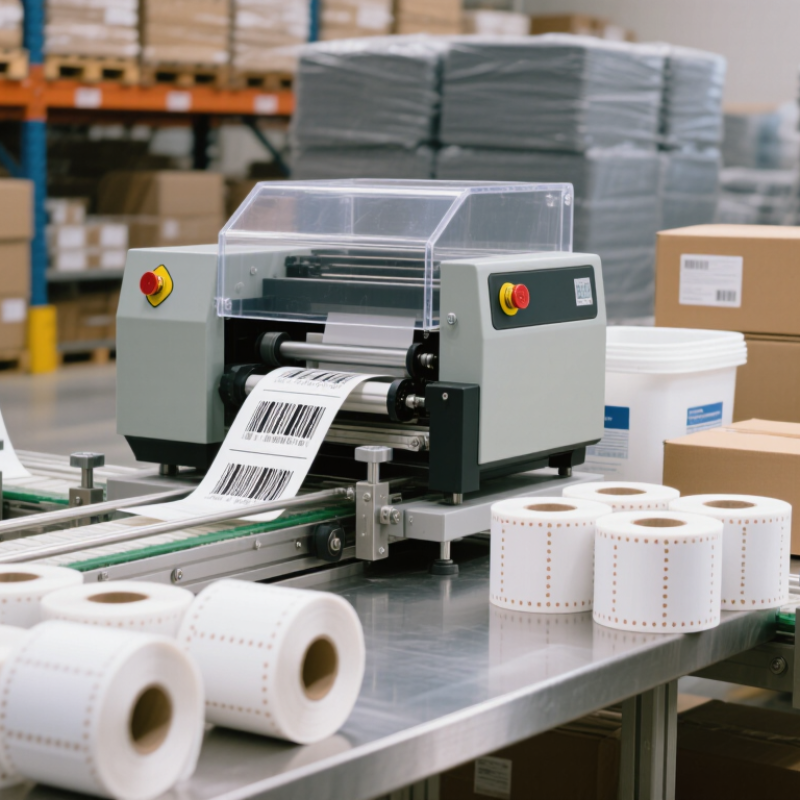
Who Makes the Best Thermal Sticker Labels in China?

What Thermal Sticker Labels Are and How They Work

Thermal sticker labels pair a printable surface with pressure-sensitive adhesive and a peel-away liner. They make sense of a small machine. Direct thermal printers use a heated printhead to darken heat-sensitive coating on the label. No ink ribbon is needed. Thermal-transfer printers instead heat a ribbon, transferring pigment onto the label face. The result depends on the label stock, ribbon, print settings, and printer condition.

That matters.
Direct thermal labels are convenient for short-lived shipping or receipt applications, but heat and sunlight can fade the image. Thermal-transfer printing often suits labels needing longer readability, provided the ribbon and face material are compatible. Grand View Research’s Thermal Paper Market Size report estimated the global thermal paper market at about US$4.3 billion in 2023. This figure covers thermal paper beyond sticker labels, so it should not be mistaken for label-market revenue.

Before choosing, test labels on the actual package. Check whether the adhesive holds on cardboard, plastic, or a cold surface, and whether barcodes remain readable after handling. Small details matter. A test print may look crisp on a desk, then fail on a damp carton. I would not assume one label type fits every workflow; storage conditions and print life deserve a second look.

Types of Thermal Sticker Labels Made in China

Chinese manufacturers produce several types of thermal sticker labels. The right choice depends on the printer, package surface, and storage conditions. Direct thermal labels darken with heat, so they need no ribbon. They work well for shipping labels, queue tickets, and short-term shelf tags. Simple and quick. However, sunlight, warm vehicles, and rubbing can fade the print sooner than expected.

Thermal-transfer labels use a ribbon to transfer ink onto the label face. They are often chosen for inventory bins, product cartons, and asset tags. Paper versions are economical, while coated paper can produce sharper barcodes. Polypropylene and polyester labels handle moisture and rougher handling better. They do require compatible ribbon settings. A sample may look crisp but still smudge on a curved bottle.

Other options include top-coated direct thermal labels, removable-adhesive labels, and freezer-grade constructions. Top coatings can improve resistance to oil and abrasion. Freezer adhesives are designed to grip cold packaging. Ask suppliers about the face stock, adhesive, liner, core size, and winding direction. Then test a roll on the actual printer and package. A small trial matters. Buyers sometimes focus on roll price and overlook fit or adhesion; specifications alone cannot replace a print-and-peel test.

How to Evaluate Chinese Thermal Label Manufacturers

Who Makes the Best Thermal Sticker Labels in China?

Evaluating Chinese thermal label manufacturers takes more than comparing quoted prices. AWA’s Global Labeling & Product Decoration Market Study estimated worldwide label demand at about 72.8 billion square meters in 2022. That figure covers many label types, but it shows why consistent converting capacity matters. Ask suppliers for roll-width tolerances, coating specifications, and batch traceability. Request samples from multiple production runs, not just a handpicked sheet. Check whether small text stays sharp and barcodes scan after rubbing, heat exposure, and storage. A polished sample can still disappoint. I have seen evaluation plans overlook adhesive performance on cold cartons; that gap can disrupt packing lines.

Tips: Test labels on your actual printer and substrate. Record print darkness, feed reliability, and adhesion after 24 hours. Ask for documented inspection results and a clear process for handling defects.

Also check whether the manufacturer can explain its quality controls in plain language. Request recent test records for basis weight, thickness, and peel adhesion, with methods and sample dates stated. Compare like with like; an impressive number without test conditions tells little. Confirm lead-time assumptions, core sizes, packaging protection, and how production changes are approved. If a supplier cannot provide repeatable samples or answer basic process questions, pause before placing a large order. One honest limitation: no single test predicts every warehouse condition, so trial labels in your real workflow before approval.

Notable Thermal Sticker Label Producers in China

China’s notable thermal sticker label producers include specialist converters and integrated paper processors, particularly in established manufacturing regions such as Guangdong, Zhejiang, and Jiangsu. Their capabilities vary: some focus on high-volume receipt and logistics labels, while others handle custom sizes, colored stock, and stronger adhesives. Grand View Research estimated the global thermal paper market at about US$4.38 billion in 2023, with projected growth through 2030. That demand makes consistency important, not just low unit prices.

For a useful supplier comparison, request samples from the same production lot and test them on your actual printers. Check barcode readability, image darkness, adhesive grip on cartons or plastic, and whether printed details fade under heat or light. Ask for coating and adhesive specifications, roll tolerances, and routine quality-control records. Small details matter. A clean-cut roll should feed smoothly, without loose edges or uneven winding. Suppliers may provide impressive test sheets, but real warehouse conditions can disagree. That is worth checking before a large order. Industry forecasts describe market growth; they do not guarantee a particular factory’s performance.

Who Makes the Best Thermal Sticker Labels in China? – Notable Thermal Sticker Label Producers in China

A practical comparison of common producer capabilities. Profiles describe supplier types, not specific companies; actual specifications and certifications should be confirmed with each supplier.

Supplier profile Thermal technology Common facestock Adhesive options Typical applications What to verify
Direct thermal label producer Heat-sensitive coating; printing does not require a ribbon Uncoated or top-coated thermal paper General-purpose, permanent, or removable pressure-sensitive adhesive Shipping, weighing, and short-term retail labels Print darkness, image life, heat and light resistance, and compatibility with the intended printer
Thermal-transfer label producer Ribbon-based printing; compatible with wax, wax-resin, or resin ribbons as specified Paper, coated paper, or synthetic film Permanent, removable, or application-specific adhesive Product identification, inventory, and labels needing longer-lasting print Facestock-ribbon match, barcode readability, abrasion resistance, and required service conditions
Custom-converting label producer Direct thermal or thermal transfer, depending on the material construction Paper or film supplied in rolls or sheets Selected to suit the target surface and application conditions Custom sizes, die-cut shapes, and application-specific label layouts Die dimensions, roll direction, core size, unwind orientation, and sample approval
Industrial and logistics label producer Usually offered in direct thermal and thermal-transfer constructions Thermal paper, coated paper, or durable synthetic film Permanent or specialized adhesive chosen for the substrate and environment Warehousing, shipping, asset tracking, and product identification Adhesion on the actual surface, barcode scanning performance, and roll consistency

Selection tip: request material specifications, printer-compatibility details, adhesive test samples, and relevant quality or compliance documents before placing an order.

How to Select a Supplier for Your Labeling Needs

Choosing a thermal-label supplier starts with the actual job, not the lowest quoted price. Specify direct thermal or thermal-transfer printing, label size, roll core, winding direction, and adhesive type. A cold warehouse, a damp carton, and a sunlit shelf place very different demands on a label. Ask for samples made with your printer and test them on the real packaging. Check barcode readability against ISO/IEC 15416 grading, rather than judging print darkness by eye.

The Smithers report The Future of Label Printing to 2028 estimates the global label market at $46.5 billion in 2023. That scale signals a broad, competitive supply base; it does not guarantee consistent rolls or reliable delivery. Request written tolerances for dimensions, coating, and adhesive, plus batch traceability and a clear process for handling defects. Ask how the supplier checks roll splices and print consistency. Small details matter. I would also compare repeat orders, not just the first sample: performance can vary between batches, and one trial cannot prove long-term consistency. A supplier who shares test records and discusses limitations is often more useful than one who promises perfection.

Who Makes the Best Thermal Sticker Labels in China?

A practical supplier-selection framework for matching label performance to your needs.

Example buyer-defined evaluation weights, not market-survey results. Adjust them to your application. Request samples and verify print quality, adhesive performance on your actual packaging, printer compatibility, applicable compliance documents, lead time, and minimum order quantity before choosing a supplier.

You've just added this product to the cart:

0
    0
    Your Cart
    Your cart is empty