

Finding the Best Thermal Paper Labels Suppliers in China takes more than comparing unit prices. A label must suit its printer, surface, and working conditions. Small differences matter. Thermal sensitivity affects image darkness, while coating quality can influence clarity and resistance to smudging. Adhesive performance matters too, especially when labels go onto cold cartons, curved containers, or dusty packaging.
A reliable comparison begins with clear specifications: label width and length, roll core size, winding direction, paper grade, and adhesive type. Ask suppliers how they check coating consistency, roll edges, and print results. Request samples before placing a large order. Test them in your own printer, then apply them to the actual packaging. Check whether barcodes scan easily and whether labels stay attached during handling. Useful evidence may include product data sheets, quality-control procedures, and examples of similar production runs. Claims alone are not enough.
This guide explores supplier capabilities, product selection, customization, communication, and order support. It also considers practical details such as sample availability, production schedules, and packaging for transport. A low quote can be attractive, but unclear specifications may create costly rework. No shortlist is perfect. Supplier strengths vary, and published information may not reveal every production constraint. Treat comparisons as a starting point, confirm important details directly, and judge each option against your real label requirements.
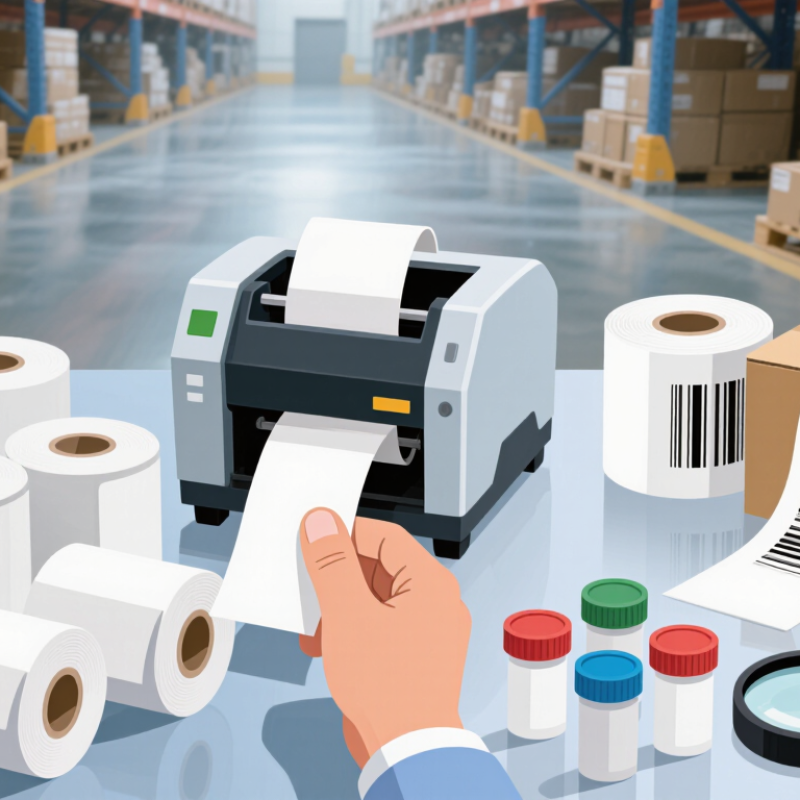
Thermal labels generally use either direct-thermal or thermal-transfer facestock. Direct-thermal paper darkens under a heated printhead; top-coated grades add a protective layer against moisture, oils, and abrasion. Thermal-transfer labels use a ribbon, so paper surface smoothness and coating affect print clarity. The 60–80 gsm range is common for paper facestock, but it describes the paper alone, not the adhesive-and-liner construction.
A 60 gsm sheet can suit lightweight shipping labels and fast-moving parcels. At 70 gsm, the face often feels firmer during dispensing. An 80 gsm option may resist curling better on larger labels, though humidity still matters. Not the full picture. Basis weight does not guarantee stiffness or print performance; thickness, coating, adhesive, and storage conditions all play a part. Request samples and test them on the actual printer.
For comparable specifications, ask suppliers for grammage and thickness results measured under ISO 536:2019 and ISO 534:2011. FINAT’s label-stock guidance also emphasizes testing the complete construction, rather than judging facestock in isolation. A useful data sheet should state the nominal grammage, thickness, thermal type, coating, and recommended storage conditions. Specifications vary by mill and grade, so treat 60, 70, and 80 gsm as reference points, not fixed performance promises.

Best Thermal Paper Labels Suppliers in China?
Supplier Quality Checks Using ISO/IEC 15416’s 0.0–4.0 Barcode Grades
When comparing thermal paper label suppliers in China, ask for verifier results, not just a dark-looking sample. ISO/IEC 15416:2016 grades linear barcodes from 0.0 to 4.0. It evaluates parameters including symbol contrast, modulation, defects, and decodability. Small details matter. The test report should state the aperture and light wavelength, because results depend on these settings. GS1 General Specifications set application-specific barcode quality requirements; some retail applications use a minimum grade of 1.5. Check the requirement for your symbol and use case rather than treating one score as universal.
Ask suppliers to test labels printed on the actual stock, using your intended printer settings and scanning conditions. Request several rolls or samples from different production runs. Compare grades, then inspect edges, coating uniformity, and adhesive behavior. A clean lab result is not the whole story. Heat, handling, and storage can affect direct thermal print quality, so test labels after exposure to realistic conditions. ISO grading measures barcode print quality at the time of verification; it does not, by itself, prove long-term durability. I would still ask for clearer aging-test details—supplier reports can leave this part vague.
ISO/IEC 15416 linear barcode print-quality grade scale
ISO/IEC 15416 grades linear barcode print quality on a 0.0–4.0 scale using scan reflectance profiles. Grade bands are F (0.0–0.4), D (0.5–1.4), C (1.5–2.4), B (2.5–3.4), and A (3.5–4.0). This chart shows the grading scale, not measured results for any supplier. When comparing thermal paper labels, assess printed samples under consistent test conditions.
China’s thermal-label suppliers are best compared by converting specifications into tests. Grand View Research estimated the global thermal paper market at about USD 4.1 billion in 2023, with growth projected through 2030. This wider market figure signals demand, but it does not prove a supplier’s label quality. Ask for coating weight, image density, and resistance test results. Print a barcode, then check it after rubbing and brief heat exposure. Small details matter.
Adhesive choice depends on the surface and environment. A label for a chilled carton needs different tack from one used on a dry shipping box. Request samples on your actual packaging, not just a coated paper swatch. Check initial adhesion, edge lift, and residue after removal. Ask suppliers to state roll width, core size, monthly output, and normal lead time. Capacity claims are easy to quote; repeat orders reveal more.
Customization may include face stock, adhesive, roll direction, perforation, and core dimensions. Compare minimum order quantities and sample fees alongside unit prices. Also ask how the supplier controls coating variation between batches. A clear inspection report helps, though it cannot replace testing on your printer. One weak point in many comparisons is treating a fast sample as proof of stable production. Record results across multiple batches before choosing a long-term source.
Choosing a thermal paper label supplier in China means checking more than price and print quality. Under the EU REACH restriction, thermal paper containing BPA at 0.02% by weight or more cannot be placed on the EU market. That threshold matters. Ask suppliers for recent test reports from a qualified laboratory, and confirm the report identifies the tested material and method. A general “BPA-free” statement is not enough evidence.
Request batch traceability and ask how the supplier controls coating changes during production. A report for one sample may not represent every later batch. I would also test labels on your actual printer and packaging surface. Check barcode clarity, adhesive grip, and performance after storage in warm conditions. Small checks can prevent costly reprints. If a supplier uses a BPA alternative, ask for supporting chemical documentation rather than assuming it is automatically suitable. No single certificate answers every question, but clear records and practical sample tests make supplier claims easier to assess.
Use the criteria below to compare suppliers. The legal limit is a regulatory requirement; other items are practical procurement checks, not claims about any particular supplier.
| Evaluation dimension | Requirement or benchmark | What to request or verify | Why it matters |
|---|---|---|---|
| EU BPA restriction | Thermal paper must not be placed on the EU market if it contains BPA at a concentration equal to or greater than 0.02% by weight. | A product-specific declaration stating the measured or verified BPA content is below 0.02% by weight. | This is the EU REACH restriction for BPA in thermal paper, applicable from 2 January 2020. |
| Unit conversion | 0.02% by weight equals 200 mg/kg (200 ppm by mass). | Check that the laboratory report identifies the unit, tested material, and result clearly. | Consistent units reduce the risk of misreading the compliance threshold. |
| Product scope | The restriction concerns thermal paper, including thermal paper used for labels and similar applications. | Confirm that the declaration and test report cover the exact thermal label face stock being purchased. | A report for a different paper grade or product may not verify the supplied material. |
| Analytical evidence | There is no single test result that should be assumed for every supplier or label construction. | Request a recent report from a competent laboratory, with the test method, sample identification, date, and detection or quantification limits stated. | Traceable testing provides stronger evidence than an unsupported “BPA-free” statement. |
| Other bisphenols | A BPA-free claim does not, by itself, establish that other bisphenols are absent. | Ask which developer chemistry is used and whether any additional substances are restricted by the destination-market requirements. | Substitution does not automatically demonstrate compliance with every chemical or customer requirement. |
| Batch traceability | No universal batch-document format is specified by the BPA concentration limit. | Check that roll or carton identifiers can be linked to production records, material specifications, and relevant test documents. | Traceability helps investigate complaints and confirm which material was supplied. |
| Label construction | Face stock, adhesive, and release liner are separate parts of a label construction; the required specification depends on the application. | Request a construction sheet describing the thermal face stock, adhesive type, liner, roll format, and any coatings. | Clear material specifications make samples and repeat orders easier to compare. |
| Print and application testing | Print performance and adhesive suitability depend on the printer, label surface, and end-use conditions. | Test samples on the intended printer and substrate; assess print readability, adhesion, and performance under expected storage and use conditions. | Compliance documentation does not establish that a label will perform in a specific application. |
| Change control | A change in paper formulation or material source can affect the relevance of prior test evidence. | Ask the supplier to notify the buyer of changes to the thermal coating, paper grade, or material source and to provide updated documentation when needed. | This helps keep compliance records aligned with the product actually delivered. |
Reference: Commission Regulation (EU) 2016/2235 amended REACH Annex XVII, Entry 66, establishing the BPA restriction for thermal paper. Confirm current legal requirements for the product and destination market before placing an order.
Best Thermal Paper Labels Suppliers in China?
Choosing a thermal paper label supplier in China starts with evidence, not a polished catalog. Request samples with the same coating and adhesive options you plan to order. Print on your own printer, then test barcode readability, smudging, and adhesion on the actual carton or container. Small details matter. A sample is only a snapshot.
Ask for the minimum order quantity by size, core, and packing format; these choices can change the quoted threshold. Confirm whether mixed specifications count toward one order. Get lead times in writing, including artwork approval, production, and pre-shipment inspection. Ask what happens if a run is delayed. A low unit price is less useful when stock arrives after your packing schedule.
Export readiness should be checked, not assumed. Request a recent packing list, carton dimensions, roll counts, and clear shipping marks. Confirm the supplier can prepare documents required by your destination and freight partner. Ask who handles inspection photos and claims. It is easy to over-trust a neat sample; sometimes the real risk is inconsistent coating between batches. Keep one approved sample and record its dimensions, print density, and peel behavior before placing a larger order.

