

Choosing a reliable hdpe bottle manufacturer takes more than comparing prices or polished catalog photos. Buyers need to examine material consistency, bottle weight, neck finish, closure fit, and production controls. A cap that feels secure on a sample may loosen after repeated handling. Small details matter.
Materials scientist Dr. Chris DeArmitt’s work supports a practical principle, paraphrased here: “Judge packaging by measured performance, not by assumptions about its material.” This guide applies that idea to ten Chinese manufacturers serving global buyers. It considers product range, customization, quality systems, production capacity, communication, and export experience. These indicators help narrow a shortlist; they do not replace factory audits or sample testing. Ask for specifications, test records, and clear answers about tolerances. Request samples in the intended size and color, then check leakage, squeezing, and closure performance under realistic conditions. Test the actual product, too.
A neat sample is not the whole story. Production batches can vary, and supplier claims deserve verification. Some buyers also underestimate lead times for custom molds and printed packaging. The ranking aims to make comparisons easier, not to promise a perfect match. Use it as a starting point, then confirm each manufacturer’s capabilities against your product, order volume, and delivery needs.
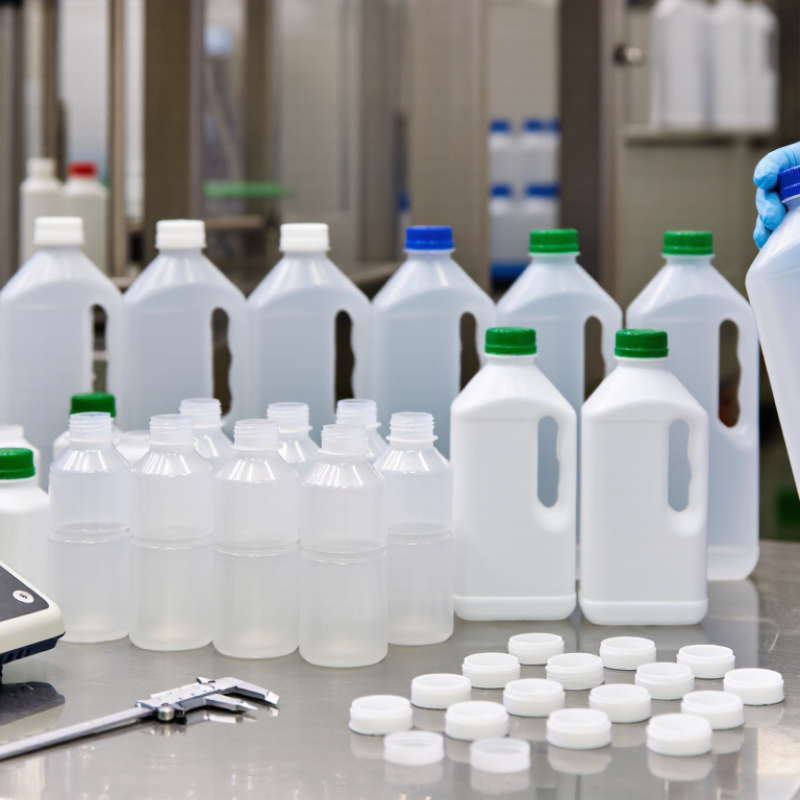
High-density polyethylene (HDPE) typically has a density of 0.941–0.965 g/cm³. That figure describes the resin, not the finished bottle’s total weight. Wall thickness, handle design, and closure choice also affect how a container feels in the hand. A one-liter bottle with a thick base may feel noticeably heavier than a thin-walled bottle of the same capacity.
Resin code #2 identifies HDPE in the resin identification system. It is a material marker, not a promise that every local recycling program accepts the bottle. For buyers, the code helps confirm the intended polymer, while a technical data sheet can clarify grade and performance details. Density alone cannot confirm chemical compatibility or resistance to a specific filling process. That shortcut can mislead.
When comparing suppliers, ask for the resin specification and representative samples. Check whether the bottle stays upright on a packing line, seals cleanly, and resists dents during handling. A simple trial with the intended liquid and closure can reveal problems that a catalog photo will not. Record the fill temperature and storage conditions, too. Small details matter. Even within the stated density range, processing and bottle geometry can produce different results, so verify the finished container rather than relying on a single number.

For global buyers, a Chinese HDPE bottle line commonly uses extrusion blow molding. An extruder melts HDPE pellets and forms a soft, hanging tube called a parison. The mold closes around it, and compressed air pushes the plastic against the cavity. After cooling, the bottle is trimmed and checked. Small details matter.
Quality checks should match the bottle’s use. Inspectors can measure weight, wall thickness, neck dimensions, and overall capacity. Leak tests reveal weak seams or inconsistent closures; drop and top-load tests assess handling strength. Ask for documented sampling plans, calibrated equipment, and batch traceability.
PlasticsEurope’s Plastics – the Fast Facts 2023 reports 400.3 million tonnes of global plastics production in 2022, with packaging representing 39% of European plastics demand. This gives useful context, though it is not a bottle-specific figure.
A polished sample alone cannot show how stable production remains across a full run.
Tips: Request test results from a recent production batch, not only a pre-production sample. Check that the test conditions match your bottle’s fill, storage, and transport needs. One missed detail can matter.
For the ten shortlisted HDPE bottle manufacturers, compare verified production capacity, not just the largest number in a sales presentation. Ask how many lines can make your bottle size, what shifts are included, and whether capacity is reserved during seasonal peaks. Plastics Europe’s Plastics – the Fast Facts 2023 reported 400.3 million tonnes of global plastics production in 2022. This is useful context for resin supply, but it does not verify any factory’s HDPE capacity. Request recent production records or a sample schedule. Capacity on paper can be misleading.
MOQ affects inventory and unit cost. A low MOQ may apply only to an existing mold or standard color; custom colors and bottle shapes can require larger runs. Ask for separate quotes for mold development, samples, and production, then clarify who owns the tooling and how changes are charged. Small details matter. A mold trial can reveal wall-thickness variation around the shoulder or an unstable base. Ask how the supplier checks these points, and request sample measurements against your drawing.
Compare lead times by stage: design approval, tooling, sample testing, and mass production. Ask whether quoted days mean calendar or working days, and whether the clock starts after deposit or final artwork approval. Get a written schedule with milestone dates. These figures are not perfectly comparable across factories; assumptions differ, and buyers often overlook that. A simple comparison sheet helps expose gaps, but verify the numbers with a pilot order before planning a full launch.
Buyer screening guide: The ten rows below are anonymous comparison scenarios, not a verified ranking or audited data for specific manufacturers. Figures are indicative planning ranges; confirm current capacity, minimum order quantities, tooling charges, and delivery schedules directly with each supplier. Actual terms vary by bottle design, resin, color, order mix, and production schedule.
| Anonymous supplier profile | Indicative capacity (bottles/month) | MOQ: existing mold (units/order) | MOQ: custom bottle (units/order) | New tooling estimate (USD; lead time) | Typical production lead time* | Potential fit |
|---|---|---|---|---|---|---|
| Profile 1 — Small-batch specialist | 100,000–400,000 | 1,000–3,000 | 5,000–10,000 | $2,000–$6,000; 25–40 days | 15–30 days | Trial orders and niche bottle formats |
| Profile 2 — Standard-format producer | 300,000–900,000 | 2,000–5,000 | 8,000–20,000 | $3,000–$8,000; 30–45 days | 18–32 days | Common household and personal-care bottles |
| Profile 3 — Multi-line packaging plant | 800,000–2,000,000 | 3,000–8,000 | 10,000–30,000 | $4,000–$10,000; 30–50 days | 20–35 days | Repeat orders and several bottle sizes |
| Profile 4 — High-volume commodity producer | 1,500,000–4,000,000 | 5,000–15,000 | 20,000–50,000 | $5,000–$12,000; 35–55 days | 22–40 days | Large, stable-volume programs |
| Profile 5 — Custom-shape focused producer | 250,000–900,000 | 2,000–6,000 | 10,000–25,000 | $5,000–$15,000; 35–60 days | 25–45 days | Distinctive shapes and tailored specifications |
| Profile 6 — Lightweight bottle producer | 500,000–1,500,000 | 3,000–8,000 | 15,000–35,000 | $4,000–$12,000; 35–55 days | 20–38 days | Weight-sensitive packaging projects |
| Profile 7 — Color and finish specialist | 300,000–1,000,000 | 3,000–8,000 | 10,000–30,000 | $3,500–$10,000; 30–50 days | 22–40 days | Colored resin and appearance requirements |
| Profile 8 — Export-oriented contract producer | 600,000–2,000,000 | 5,000–12,000 | 15,000–40,000 | $4,000–$12,000; 35–55 days | 25–45 days | Buyers needing export documentation and coordination |
| Profile 9 — Industrial-container producer | 700,000–2,500,000 | 3,000–10,000 | 10,000–30,000 | $5,000–$15,000; 35–60 days | 25–45 days | Larger formats and functional packaging |
| Profile 10 — Integrated packaging supplier | 1,000,000–3,000,000 | 5,000–15,000 | 15,000–40,000 | $5,000–$15,000; 35–60 days | 25–45 days | Projects requiring coordinated bottle and closure supply |
Comparison notes: Capacity depends on bottle size, mold cavities, machine availability, and shifts. Tooling estimates are broad planning figures and may exclude design work, testing, taxes, or shipping. Production lead time generally starts after specification approval, tooling or sample approval where applicable, and deposit receipt. Ask suppliers to state capacity for your exact SKU and to separate sample, tooling, and mass-production schedules.
GB 4806.7-2023 took effect on 6 September 2024, setting food-contact requirements for plastic materials and articles in China. For HDPE bottles, buyers should check that the resin, colorants, and processing aids comply with applicable requirements. Migration results should reflect the intended food type, contact time, and temperature—not just a convenient laboratory condition. Looks can mislead. Request current test reports, a food-contact compliance statement, and batch traceability. The bottle, cap, and liner may each need separate assessment.
Export compliance is not automatic. China’s standard does not replace destination-market rules, such as EU Regulation 10/2011 or applicable US food-contact requirements. OECD’s Global Plastics Outlook (2022) estimated that packaging generated about 40% of global plastic waste in 2019, underscoring why material control and traceability deserve careful attention. Ask manufacturers to identify the tested bottle specification, including wall thickness and color, and to explain any differences from production samples. Keep records. One weakness in many sourcing reviews is the focus on the bottle alone; caps and liners can be overlooked. That gap is easy to miss, especially when procurement teams are working from short supplier checklists.
A useful supplier comparison starts with a sample, not a polished product photo. Request bottles made with the same resin, mold, color, and closure planned for production. Fill one with your actual product and check for leaks, odor, deformation, and cap fit after storage. Measure the neck finish and wall thickness; small variations can disrupt filling lines. Ask for evidence.
Review certificates carefully. Confirm they apply to the specific factory and product, and check their validity and scope. Requirements vary by destination and intended use, so buyers should verify them with qualified local advisers. A certificate image alone is not enough. Request supporting test reports and clear answers about material traceability.
Export experience matters in practical ways. Ask how the supplier handles carton strength, pallet loading, lead times, and damaged-goods claims. A past shipment reference or redacted export document can help substantiate experience. Compare total cost, not just the unit quote: include tooling, samples, freight, duties, inspection, and expected breakage. The cheapest offer may become expensive. I have seen buyers underestimate freight and rework; it is an easy mistake, but worth challenging before placing an order.

