
Top 10 Meat Vacuum Sealer Manufacturers in China

China’s meat vacuum sealer manufacturers serve processors, butcher shops, and food brands with very different production needs. A busy packing line needs repeatable seals and fast cycle times. A neighborhood butcher may care more about countertop size, simple controls, and accessible service. Small details matter.

The scale is substantial. FAO’s 2024 Statistical Yearbook reports global meat production of roughly 360 million tonnes in 2022, while Grand View Research’s vacuum-packaging analysis identifies food packaging as a major market application. These figures do not measure sealer sales directly. They do show why dependable packaging equipment matters across the meat supply chain. For buyers, pump capacity alone is not enough. Chamber dimensions, seal-bar consistency, spare-parts availability, and clear operating instructions deserve equal scrutiny.

Food-packaging specialist Dr. Aaron L. Brody’s work points to a practical principle: packaging performance depends on the integrity of the package, not simply on removing air. This is a paraphrase, not a direct quotation. That distinction matters when comparing supplier claims with test results. The manufacturers in this guide are assessed through product range, production capability, quality controls, and export support. Yet no ranking can replace a sample run with your own bags and products. That is an imperfect step, but a useful one. The right meat vacuum sealer should deliver consistent seals in the real conditions of your operation—not just look impressive in a catalogue.
Top 10 Meat Vacuum Sealer Manufacturers in China

How Meat Vacuum Sealers Support Meat Processing and Preservation

How Meat Vacuum Sealers Support Meat Processing and Preservation

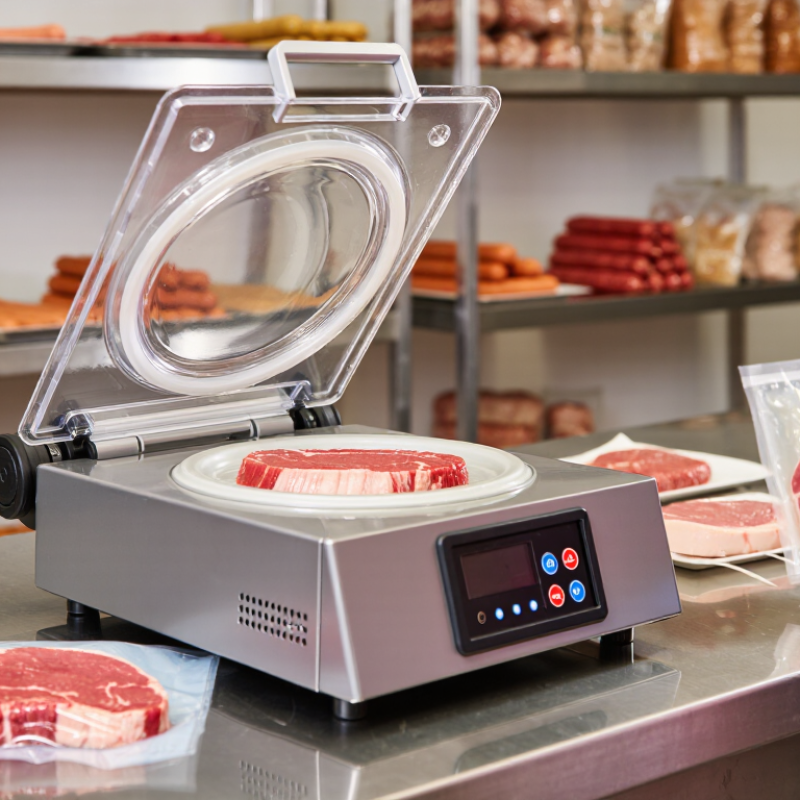
Meat vacuum sealers remove much of the air around products before creating a closed package. Less oxygen can slow oxidation, helping preserve color and flavor during refrigerated storage. It also reduces exposure to air and handling after packing. Small details matter. A pouch with fresh steaks, for example, needs a seal that stays intact despite moisture and movement.

In processing facilities, vacuum sealing can support portioning, storage, and shipment. Operators can package cuts in consistent sizes, stack them more neatly, and label them for traceability. Equipment choice depends on product volume, package material, cut size, and cleaning routines. A chamber machine may suit frequent packing of wet or irregular cuts, while other setups fit different production needs. The best specification is not always the fastest cycle.

Vacuum packaging does not sterilize meat or replace refrigeration. Safe temperature control and hygienic handling remain essential throughout processing and distribution. A tight-looking pouch can still hide a weak channel seal, so visual checks alone are not enough. Staff should inspect seals and follow documented checks suited to their line. This takes time. It is easy to underestimate cleaning and maintenance when comparing machines, yet worn sealing bars or residue can disrupt production. Sealer performance depends on both the equipment and the daily habits around it.
Key Criteria for Evaluating Chinese Vacuum Sealer Manufacturers

Key Criteria for Evaluating Chinese Vacuum Sealer Manufacturers

A capable meat vacuum sealer manufacturer should show how its machine performs, not just quote pump capacity. Ask for sealing-cycle tests using your actual pouch material, thickness, and meat moisture level. Watch the seal cool, then inspect it for wrinkles, channels, or trapped liquid. Small defects matter. Request cycle-time data at the intended production speed, and confirm whether figures include loading and unloading.

Factory audits should cover stainless-steel contact surfaces, weld quality, electrical protection, and spare-part availability. Ask for maintenance schedules and written acceptance criteria. A polished demonstration is useful, but it is not a substitute for repeatable test records. The Grand View Research Vacuum Packaging Market report estimated the global market at USD 29.5 billion in 2023, with projected growth through 2030. That broad market figure is not specific to sealers, but it signals why buyers should distinguish marketing claims from measured machine performance.

Check whether the supplier can provide traceable quality records and support commissioning, operator training, and troubleshooting. For meat applications, ask how the equipment handles liquid near the sealing area and how cleaning access is designed. Request references from comparable production lines, then verify response times directly. One limitation remains: factory tests may not match your shifts, film, or operators. A practical trial at your site can reveal what paperwork misses.

Key Criteria for Evaluating Chinese Meat Vacuum Sealer Manufacturers

Suggested buyer-priority weighting for supplier evaluation. These are framework weights, not measured scores or company-specific data.

How to use this chart: Compare suppliers using documented seal-performance tests, applicable food-contact compliance records, production consistency, machine construction, quality-control traceability, and after-sales support. Adjust the weights to match your product, market, and purchasing priorities.

Profiles of 10 Leading Meat Vacuum Sealer Manufacturers in China

China’s meat vacuum sealer manufacturers serve processors ranging from small butcher shops to high-throughput plants. These ten profiles focus on practical differences: chamber size, sealing-bar length, pump capacity, cycle time, and service support. A compact single-chamber unit may suit a neighborhood processor, while a belt-fed system handles continuous production. Numbers matter. But only under real workloads.

The FAO’s 2019 report, The State of Food and Agriculture, estimates that 14% of food is lost between harvest and retail worldwide. That figure covers food generally, not meat alone, but it highlights why dependable packaging and cold-chain handling deserve attention. For each manufacturer, buyers should ask how machines perform with moist cuts, oily surfaces, and repeated daily cycles. Request sample packs, inspect seal consistency, and confirm whether replacement heaters and pumps are readily available.

A polished brochure can hide useful details. Check whether quoted output reflects actual product size and operator pace, not an ideal test run. Compare stainless-steel contact surfaces, cleaning access, control-panel clarity, and warranty response times. Some suppliers may offer customization, though unusual chamber dimensions can complicate maintenance. That trade-off is easy to miss. Reliable profiles should separate verified specifications from sales claims and explain where each machine fits.

Comparing Manufacturer Capabilities, Products, and Certifications

Comparing China’s meat vacuum sealer manufacturers requires more than checking machine speed. Grand View Research estimated the global vacuum packaging market at USD 29.6 billion in 2023, with projected growth through 2030. That demand makes production capacity relevant, but a large factory does not guarantee consistent sealing. Ask for cycle-time data using your pouch size, meat temperature, and daily workload. Then inspect weld width, seal consistency, and performance during extended runs. Small details matter.

Product range is another useful comparison point. Some manufacturers offer tabletop units for small processors, while others build double-chamber or conveyor systems for higher throughput. Check whether the machine supports wet products, adjustable vacuum settings, and easy-to-clean contact surfaces. Request a demonstration with a representative meat sample. A polished showroom test is not enough. It may not reflect a busy shift.

Certifications need careful reading. ISO 9001 indicates a quality-management system, while CE documentation concerns applicable European product requirements; neither alone proves food-contact suitability. Request material declarations, test reports, and certificate scopes for the exact model. Compare after-sales response times, spare-part availability, and warranty terms as well. One limitation in many comparisons is the lack of independently verified factory data. Treat supplier claims as starting points, not final evidence.

Top 10 Meat Vacuum Sealer Manufacturers in China - Comparing Manufacturer Capabilities, Products, and Certifications

This is an anonymized due-diligence comparison template, not a verified ranking. No company-specific evidence was supplied, so manufacturer capabilities, products, and certifications are marked as unverified rather than presented as facts.

Reference Product scope to confirm Meat-packaging capability to verify Manufacturing evidence to request Certification and compliance evidence to request Current evidence status
Candidate 01 Chamber vacuum sealer models and compatible chamber sizes Bag dimensions, sealing-bar length, seal-layer compatibility, and cycle performance with representative meat products Factory address, production process overview, model-specific specifications, and a live production or inspection record Current ISO 9001 certificate, if claimed; verify certificate holder, scope, site, and validity Not independently verified
Candidate 02 External or nozzle-type vacuum sealer models Supported embossed-bag types, package dimensions, and suitability for moist-product workflows Model-specific user manual, parts list, rated power, and documented quality-control checkpoints Applicable market conformity documents and a model-specific declaration of conformity, where required Not independently verified
Candidate 03 Single-chamber commercial vacuum sealers Chamber dimensions, pump specifications, sealing configuration, and stated duty cycle Evidence that the offered model is manufactured at the stated facility; request a factory audit or third-party inspection Certificate copies with issuing-body details and a way to confirm current validity Not independently verified
Candidate 04 Double-chamber commercial vacuum sealers Chamber layout, output claims, power requirements, and sealing performance under the intended operating conditions Production capacity figures tied to a defined period, plus inspection and final-test records for the quoted model Electrical safety and electromagnetic-compatibility documentation applicable to the destination market and model Not independently verified
Candidate 05 Continuous or belt-fed vacuum packaging equipment Line speed, product-size limits, integration requirements, and compatibility with the specified packaging material Factory acceptance-test procedure, installation requirements, and service-parts availability information Risk assessment and applicable machinery-safety documentation for the exact configuration Not independently verified
Candidate 06 Vacuum sealer models with gas-flush or modified-atmosphere options Gas supply requirements, flushing controls, sealing consistency, and validation needs for the buyer’s process Configuration-specific drawings, operating instructions, and factory test results for the selected options Documentation for the supplied gas-system components and applicable local installation requirements Not independently verified
Candidate 07 Custom-sized or OEM-configured vacuum sealing equipment Written confirmation of dimensions, electrical configuration, interface requirements, and acceptance criteria Approved drawings, change-control process, sample approval, and a pre-shipment inspection plan Compliance documents covering the final customized configuration, not merely a similar standard model Not independently verified
Candidate 08 Tabletop and small commercial vacuum sealers Intended-use limits, sealing-bar dimensions, supported bag materials, and declared operating cycle Product specification sheet, serial-number traceability method, warranty terms, and spare-parts list Destination-market product documentation and any applicable electrical safety test reports Not independently verified
Candidate 09 Heavy-duty commercial vacuum packaging equipment Published pump and sealing specifications, cleaning access, and suitability for the buyer’s production environment Maintenance schedule, service response terms, critical-component list, and documented final inspection Evidence for any claimed management-system or product certification, checked against its issuer and scope Not independently verified
Candidate 10 Vacuum sealers bundled with compatible packaging accessories Confirmed compatibility between the machine, bag or film specification, and the buyer’s intended package format Separate specifications and traceability details for the machine and each supplied accessory Food-contact declarations or test reports for packaging materials, where required by the destination market Not independently verified

Verification note: ISO 9001 is a quality-management-system standard, not a product certification. CE marking is a conformity marking for applicable European Union legislation, not a general quality award. Food-contact compliance depends on the material, intended use, and destination market; request relevant declarations and test evidence for the exact material or product. Verify every document against the named legal entity, manufacturing site, model, scope, issuing body, and validity period.

How to Assess Suppliers and Source Meat Vacuum Sealers in China

When assessing meat vacuum sealer suppliers in China, start with the actual work the machine must handle. List daily pack volume, product temperature, bag dimensions, and available power. Fresh meat can release liquid, so ask how the sealing bar and pump perform during repeated wet-product cycles. Small details matter. Request a sample unit and test it with your own bags and cuts, not just an empty chamber.

Check the supplier’s experience with comparable equipment and ask for clear, current specifications. Look for pump capacity, seal width, cycle time, chamber dimensions, and replacement-part availability. Ask for factory test records, operating instructions, and a warranty in writing. A video call can help you inspect assembly and quality checks, but it is not a substitute for testing. I have seen buyers focus on price and overlook whether seals stay consistent after many cycles. That is an easy mistake to make.

Before ordering, confirm minimum quantities, lead time, packaging, payment milestones, and who handles freight arrangements. Compare the total landed cost, including sample freight, spare parts, and service support. Ask which documents the supplier can provide for your destination market, then verify requirements with the relevant authority or importer. Keep specifications and agreed changes in writing. Communication may seem smooth before payment, yet small misunderstandings about voltage or bag size can become expensive. A modest trial order can reveal gaps, though it will not prove long-term durability.

You've just added this product to the cart:

0
    0
    Your Cart
    Your cart is empty